The role of structural and functional parameters in designing pathology-specific tDCS protocols for primary progressive aphasia
Abstract
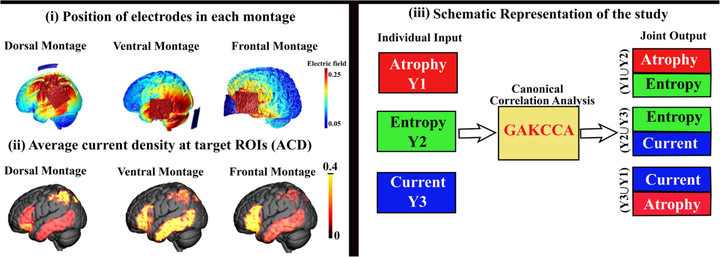
The non-fluent and semantic variants of primary progressive aphasia associated with frontotemporal lobar degeneration show distinct structural and functional abnormalities. Because transcranial direct current stimulation current distribution depends on brain structure and function, a single arbitrary montage may be inappropriate across variants. This study used T1-weighted and resting-state fMRI data from healthy controls and patients with non-fluent or semantic primary progressive aphasia to evaluate grey matter volume, functional entropy, and electric-field models for dorsal, ventral, and frontal tDCS montages. Atrophy distribution primarily influenced current spread and montage suitability. The frontal montage was identified as most suitable for non-fluent primary progressive aphasia, while the ventral montage was most suitable for semantic primary progressive aphasia. The findings support pathology-specific tDCS montage selection for variant-based modulation of the language network.

Sagarika Bhattacharjee
Assistant Professor, Department of Neurophysiology