Personalized Transcranial Direct Current Stimulation for Behavioral and Neurophysiologic Outcomes
Abstract
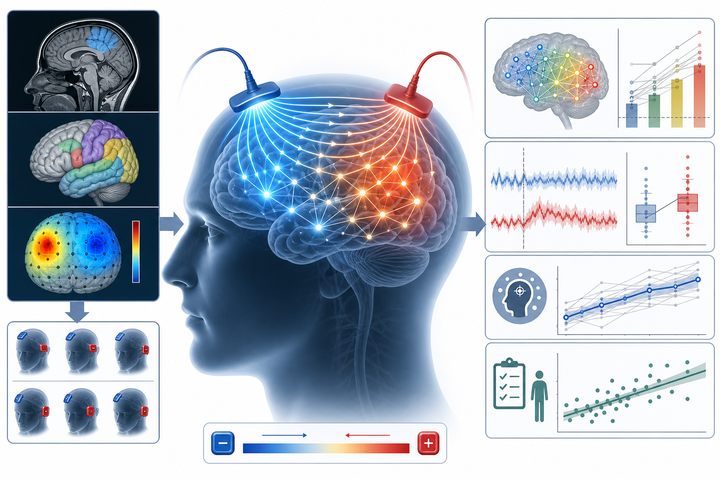
Transcranial direct current stimulation (tDCS) is emerging as a home-based intervention for neuropsychiatric conditions and cognitive enhancement, but its effectiveness is limited by interindividual variability because fixed-dose protocols do not account for anatomical differences that influence current delivery. This comparative effectiveness study used a within-participant, double-masked, crossover design to compare fixed-dose, individualized-dose, and sham stimulation in adult bilingual participants. Individualized dosing was calculated with a custom simulation toolbox. Behavioral performance was measured with reaction time during a rapid naming task and neurophysiological effects were assessed using motor-evoked potentials. Individualized-dose tDCS was associated with greater reaction-time improvement over sham than fixed-dose tDCS, lower variability in response, and conversion of several nonresponders to responders. Neurophysiological measures also showed stronger poststimulation effects for individualized dosing. These findings support dose-controlled tDCS as a more consistent approach for behavioral and neurophysiological improvement.

Sagarika Bhattacharjee
Assistant Professor, Department of Neurophysiology