Longitudinal evaluation of common and unique brain-networks in variants of primary progressive aphasia
Abstract
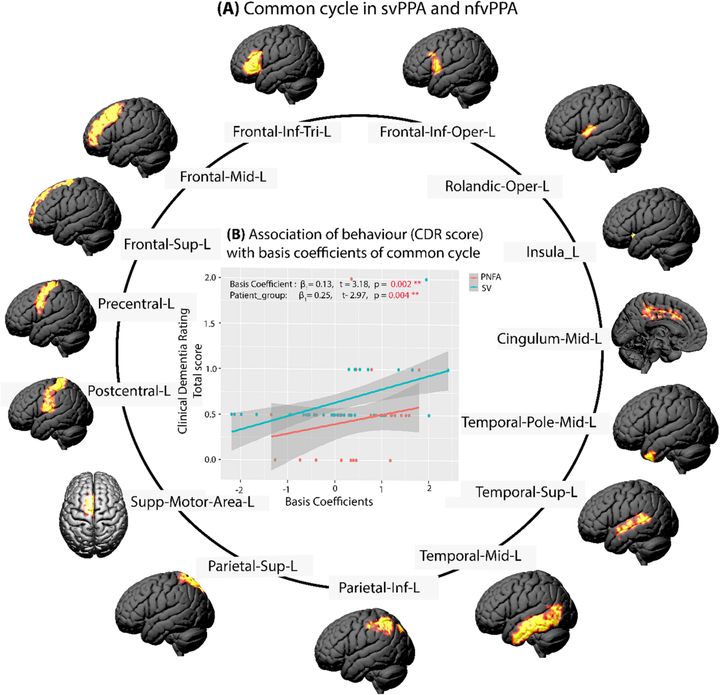
Semantic and non-fluent variants of primary progressive aphasia show both shared and distinct features, reflecting changes in underlying brain networks. This study used individualized resting-state fMRI and algebraic-topology methods to examine common and variant-specific networks in patients with non-fluent and semantic primary progressive aphasia and matched controls. The analyses identified a left-lateralized common network associated with language and cognition that remained relatively stable over 12 months and related to dementia severity. Variant-specific right-dominant networks showed progressive disintegration, with cerebellar dissociation linked to daily-life decline in semantic primary progressive aphasia and parietal degradation linked to naming impairment in non-fluent primary progressive aphasia. Structural connectivity and grey matter findings supported the functional network results. The findings suggest that rehabilitation strategies for primary progressive aphasia should consider right-hemispheric network progression alongside conventional left-hemispheric approaches.

Rajan Kashyap
Assistant Professor (Ramalingaswami Fellow), Department of Neuroimaging and Interventional Radiology