National identity reconfigures brain responses from them to us
Abstract
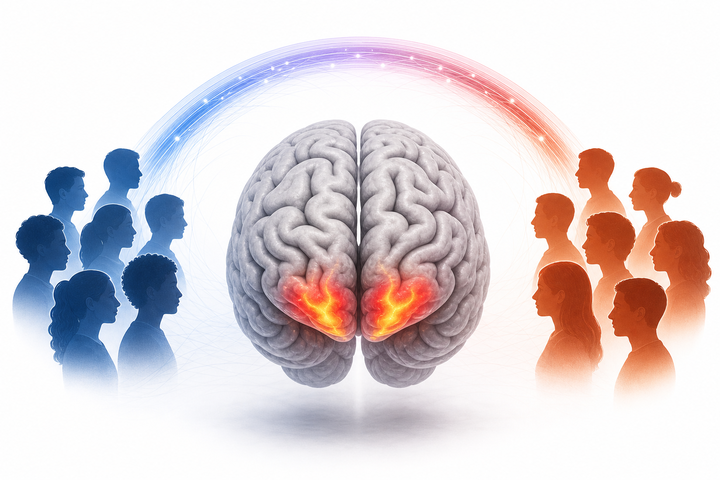
How the human brain flexibly adapts social perception by recategorizing out-group (them) to in-group (us) remains unclear. Using functional MRI in Singapore’s multicultural population, we investigated how priming subordinate (ethnic) versus superordinate (national) identities reshapes neural processing of ethnic in-group and out-group faces. We demonstrate that the ventromedial prefrontal cortex, a hub for self-referential processing, preferentially activates for ethnic in-group faces under ethnic identity priming, while showing increased engagement for ethnic out-group faces under national identity priming. Representational similarity analyses reveal that national priming reduces the neural representational distance between in-group and out-group faces, though ethnic distinctions persisted. These findings provide neural evidence for the Common Ingroup Identity Model, revealing a partial recategorization process in which superordinate identity priming increases self-referential processing of former out-group members while maintaining underlying ethnic category distinctions. These results elucidate the neural mechanisms supporting identity flexibility with implications for improving intergroup relations in diverse societies.